
A key demand is to reduce the dividend distribution tax on listed firms.

Taking its price war with main rival National Stock Exchange (NSE) up a notch, the Bombay Stock Exchange (BSE) has announced the waiver of all transaction charges for brokers from semi-urban areas with effect from next month.

Exposure to debt funds and gold is essential even if current returns from these asset classes are low, suggests Sanjay Kumar Singh.

Capital markets regulator Sebi Chairman U K Sinha advocated the listing of bourses and greater competition among exchanges.

Equity benchmarks ended modestly higher on Friday after the Reserve Bank raised the key interest rate in an effort to cool stubbornly high inflation and defend the rupee. Continuous foreign fund inflows into the capital markets and softening crude oil prices also helped the bourses regain momentum, traders said. The 30-share BSE Sensex ended 89.13 points or 0.15 per cent higher at 58,387.93 after facing volatility during the fag-end of trade. During the day, it climbed 350.39 points or 0.60 per cent to 58,649.19. The broader NSE Nifty went up by 15.50 points or 0.09 per cent to finish at 17,397.50.

In May 2019, Sebi had penalised the NSE as well as two of its former heads - Narain and Chitra Ramkrishna - for allowing Sampark to provide the dark fibre connectivity to stock brokers, despite not having the authorised licence. Dark fibre refers to an unused optical fibre used for high-speed connectivity.

The surge in the stock market has failed to stem the trend of small-sized brokers shutting operations.

The stock markets need not be an enigma - use resources at your disposal
Capital markets regulator Sebi has tweaked peak margin rules which will bring huge relief to traders and brokerage houses that have been incurring high margin penalties so far, experts said on Wednesday. Under the new framework, the beginning of the day margin will be considered as peak margin. This is only in respect of the collection of upfront margin. The peak margin rule that was implemented last year restricted brokers' ability to fund clients' intraday positions.
Brokers od bothe the Bombay Stock Exchange and National Stock Exchange on Tuesday demanded a single transaction tax on securities for only foreign institutional investors and non-resident Indians and asked Finance Minister P Chidambaram
According to sources, the market regulator is planning to introduce colour forms for client registration in a bid to stop brokers from making changes after a client has filled up the form. Currently, there are boxes each for cash derivatives and debt, and investors have to indicate whether they want to trade in the cash market or futures and options. In some cases, brokers themselves click on the derivatives option without the permission of the client.

Besides, the capital market regulator would ask all the market entities, including brokers and mutual funds, to implement the new common know your client norms even for their existing clients in a phased manner.

Tata Steel was the top gainer in the Sensex pack, jumping over 6 per cent, followed by Sun Pharma, L&T, M&M, PowerGrid, Bajaj Finserv, TCS and Infosys. On the other hand, Wipro, Asian Paints, HDFC Bank, IndusInd Bank and HCL Tech were among the laggards.

US short-seller Hindenburg Research had shared an advance copy of its damning report against Adani group with New York-based hedge fund manager Mark Kingdon about two months before publishing it and profited from a deal to share spoils from share price movement, according to market regulator Sebi. The Securities and Exchange Board of India (Sebi), in its 46-page show cause notice to Hindenburg, detailed how the US short seller, the New York hedge fund and a broker tied to Kotak Mahindra Bank benefited from the over USD 150 billion routs in the market value of Adani group's 10 listed firms post-publication of the report.

Madhabi Puri Buch, the first female chairperson of Sebi, doesn't plan to rest on her laurels in her third and final year in office and has set out an ambitious goal, such as moving towards a same-day and instantaneous settlement cycle for the secondary market.

India's stock exchanges have decided to jointly introduce the T+1 settlement cycle in phases from February 25, beginning with the bottom 100 stocks by market capitalisation. From March 2022, on the last Friday (or the immediate next trading day) of every month, the next 500 stocks from the bottom will be subject to T+1 settlement. The phase-wise implementation is expected to give all market participants, including foreign portfolio investors (FPIs), ample time to shift to the shorter cycle. The settlement cycle represents the time period within which the stock exchanges have to settle security transactions.

Smaller players may find it difficult to bear the costs associated with such a requirement.

The government has imposed anti-money laundering provisions on cryptocurrencies or virtual assets as it looks to tighten oversight of digital assets. In a gazette notification, the Finance Ministry said the anti-money laundering legislation has been applied to crypto trading, safekeeping and related financial services. After this, Indian crypto exchanges will have to report suspicious activity to the Financial Intelligence Unit India (FIU-IND).

In its master circular on general insurance products, which takes immediate effect, Irdai specified, 'The customer may be required to submit only those documents directly related to claim settlement.'

This was a fresh probe based on the inspection of certain derivative contracts both on the BSE and NSE.

After the Bombay Stock Exchange (BSE) Brokers Forum, the Association of National Stock Exchange Members of India (ANMI) has decided to approach the government and the Securities and Exchange Board of India (Sebi) on extension of trading hours from January 4.

Regulator proposes mutual fund model for infrastructure debt funds.

'Gold prices thrive on volatility and more so when the stock markets trend downward.'

The regulator has decided to allow registered brokers (including trading members) of stock exchanges to provide security market access to their clients through authorised persons. The regulation follows the recommendations made by the Secondary Market Advisory Committee of Sebi and discussions with the stock exchanges.

Within the next 3 months, most brokers will enable you to intelligently invest via mobiles in MFs, FDs, and IPOs.

The retail broking industry's top line could more than double over the next five years, according to the estimates of consultancy firm Bain & Company. The industry, which facilitates stock market trading for investors, has already witnessed its revenues double from Rs 14,000 crore during 2018-19 (FY19) to Rs 27,000 crore in 2022-23 (FY23), reflecting an annualised growth rate of 17 per cent. "This growth has been fuelled by the emergence of India's mass-affluent and affluent segments, coupled with increasing financial literacy.

The rupee extended its losses and slumped 60 paise to close at a record low of 77.50 (provisional) against the US dollar on Monday, pressured by the strength of the American currency overseas and unabated foreign fund outflows. Forex traders said risk appetite has weakened amid mounting concerns about inflation that may trigger more aggressive rate hikes by global central banks. At the interbank foreign exchange market, the rupee opened lower at 77.17 against the greenback, and finally settled for the day at 77.50, down 60 paise over its previous close.
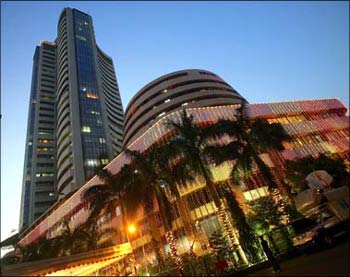
Leading stock exchange BSE has initiated a process of putting in place a new risk-based model for supervision of market entities including brokers, taking forward a new model proposed by regulator Sebi in this regard.

The Bombay Stock Exchange brokers plan to take up extending trading hours with the Prime Minister and market regulator Sebi.

Equity benchmark Sensex on Monday crashed about 1,546 points to sink below the 58,000-level due to across-the-board selloff tracking sluggish global markets. Besides, persistent foreign capital outflows continued to affect the market sentiment, traders said. Benchmark indices started the session on a weaker note and the selling intensified during afternoon trade, with almost all sectoral indices ending in the red. The 30-share BSE Sensex ended 1,545.67 points or 2.62 per cent lower at 57,491.51.
Before framing regulations to curb 'misleading' messages and stock recommendations by finfluencers (a portmanteau of the phrase 'financial influencers'), the market regulator plans to put in place some 'building blocks' to ensure smooth enforcement. Madhabi Puri Buch, chairperson of Securities and Exchange Board of India (Sebi), is of the view that the 'traditional approach may not work' to rein in finfluencers. "There are many interlinked pieces in our regulations - investment advisor regulations, research analyst regulations, the fact that we don't have algorithmic (algo)-related regulations, what brokers are permitted to do, and what is incidental advice.

Corporate earnings grew in double digits during the April-June 2022 (Q1FY23) quarter but the momentum waned. Overall corporate earnings in the quarter were down sharply from their highs in FY22. The combined net profit of 2,981 listed companies across sectors in the Business Standard sample was up 22.4 per cent YoY to Rs 2.24 trillion in the June quarter, driven by a big jump in the earnings of banks, non-banking lenders, oil & producers, and FMCG companies. Also, earnings in the corresponding quarter a year ago were affected because of the second wave of the Covid pandemic, even though the numbers were a lot better than Q1FY21 when there was a nationwide lockdown.
 © 2026 Rediff.com - Investor Information - Advertise with us - Disclaimer - Privacy Policy - Sitemap - Feedback - About us - Terms of use - Grievances